Little Big Wars
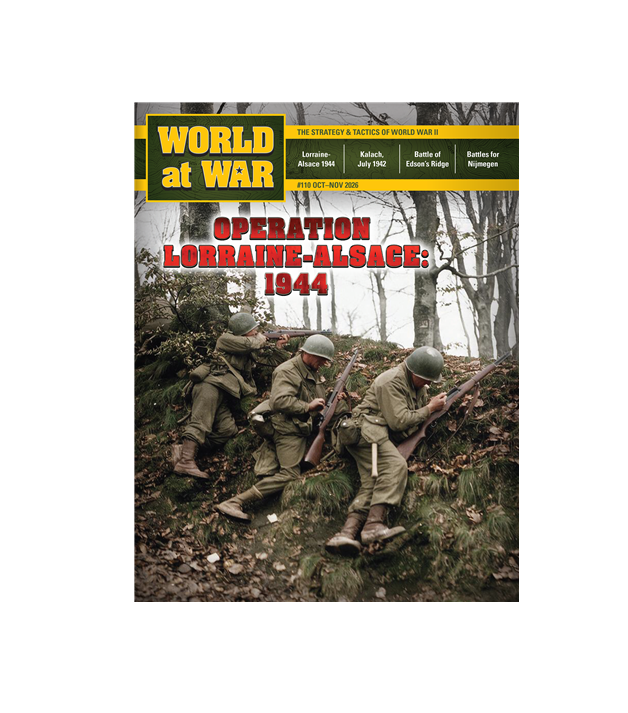
World At War Magazine #110 Operation Lorraine-Alsace 1944
World At War Magazine #110 Operation Lorraine-Alsace 1944
Regular price
$54.99
Regular price
$54.99
Sale price
$54.99
Unit price
per
Shipping calculated at checkout.
Couldn't load pickup availability
World At War Magazine #110 Operation Lorraine-Alsace 1944
Operation Lorraine-Alsace: 1944 Three of the plans for a west front counteroffensive that Hitler’s staff prepared for his consideration were for attacks in Lorraine and Alsace. Their common aim would have been to wreck as many US and French divisions as quickly as possible. If successful, it would temporarily stop the overall Allied advance, consume their reserves, draw their air forces away from striking the Ruhr, and restore the strong Vosges Mountain line. The Fuehrer rejected them, but here is our analysis of their chances for success.
Articles:
The Battle for Kalach, 25 July–11 Aug. 1942 In a series of engagements between 25 July and 11 August 1942, German Sixth Army and the Soviet Stalingrad Front battled for control of the Don River bend west of Kalach. Ultimately a German tactical victory, it paved the way for their entry into Stalingrad.
Edson’s Ridge, 12–15 September 1942 The Guadalcanal campaign opened on 7 August 1942, when the US 1st Marine Division went ashore there, catching the Japanese by surprise. However, by early September, the Japanese were preparing for a showdown. They had assembled 6,200 veteran soldiers and developed a plan to breakthrough the US perimeter at is southernmost point, an elevation that has gone into the history books as Edson’s (aka Bloody) Ridge. The fighting there proved to be the turning point of the whole battle for the island.
The Battle(s) of Nijmegen Operation Market-Garden called for paratroops to seize six bridges, and everyone knew even one failure could result in the campaign’s defeat. On the first day, 1st Battalion (508th Parachute Infantry Regiment, 82nd Airborne Division) did not advance from its drop zone to take the bridges in Nijmegen town until 1800. That delay gave the Germans time to prepare a successful defense, and it has ever since been described as due to a “miscommunication” between the division’s and the regiment’s commanders.
Operation Lorraine-Alsace: 1944 Three of the plans for a west front counteroffensive that Hitler’s staff prepared for his consideration were for attacks in Lorraine and Alsace. Their common aim would have been to wreck as many US and French divisions as quickly as possible. If successful, it would temporarily stop the overall Allied advance, consume their reserves, draw their air forces away from striking the Ruhr, and restore the strong Vosges Mountain line. The Fuehrer rejected them, but here is our analysis of their chances for success.
Articles:
The Battle for Kalach, 25 July–11 Aug. 1942 In a series of engagements between 25 July and 11 August 1942, German Sixth Army and the Soviet Stalingrad Front battled for control of the Don River bend west of Kalach. Ultimately a German tactical victory, it paved the way for their entry into Stalingrad.
Edson’s Ridge, 12–15 September 1942 The Guadalcanal campaign opened on 7 August 1942, when the US 1st Marine Division went ashore there, catching the Japanese by surprise. However, by early September, the Japanese were preparing for a showdown. They had assembled 6,200 veteran soldiers and developed a plan to breakthrough the US perimeter at is southernmost point, an elevation that has gone into the history books as Edson’s (aka Bloody) Ridge. The fighting there proved to be the turning point of the whole battle for the island.
The Battle(s) of Nijmegen Operation Market-Garden called for paratroops to seize six bridges, and everyone knew even one failure could result in the campaign’s defeat. On the first day, 1st Battalion (508th Parachute Infantry Regiment, 82nd Airborne Division) did not advance from its drop zone to take the bridges in Nijmegen town until 1800. That delay gave the Germans time to prepare a successful defense, and it has ever since been described as due to a “miscommunication” between the division’s and the regiment’s commanders.